
The invoice your accountant would have raised
Approve a bill in Stalmio and it arrives in Xero or wFirma as a sales invoice: your contact, your account codes, your tax rates. Your accountant still issues it, still numbers it, and still owns the ledger.
Replaces: re-typing every bill into the accounts package, and the month-end argument about which ones were missed.
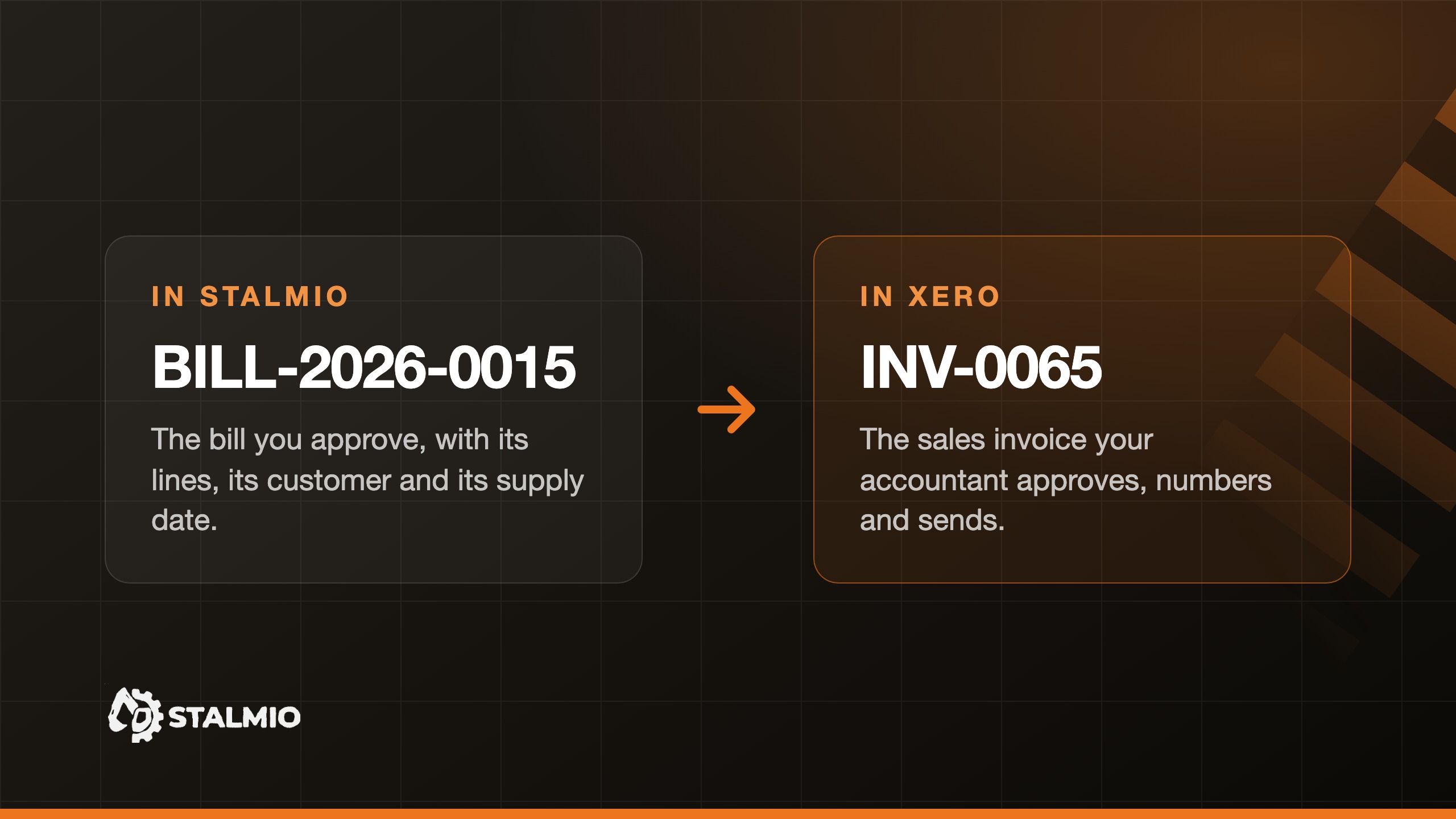
How it goes today
- Every bill gets typed twice: once by the person who did the work, and once by whoever keys it into the accounts.
- The second typing is where the account code, the tax rate and the customer name quietly stop matching.
- Deposits are the worst of it. Money taken before a supply is not revenue, and a spreadsheet is usually what decides whether it lands as one.
What Stalmio does instead
- A bill you approve becomes a sales invoice in Xero or wFirma, on your own account codes and tax rates.
- Deposits post to a liability and are applied when the supply happens, so they never look like revenue.
- One invoice per bill, re-read rather than re-created, so a retry can never leave a duplicate behind.
What happens
You approve the bill
The bill is the ordinary Stalmio document: the machine, the hire period, the labour, the parts, the delivery. Approving it is the only new step, and you can see exactly what will be sent before anything is sent.
It arrives in your accounting system
As a sales invoice against your contact, on your own account codes and tax rates, split by what was actually sold: machine sales, hire, workshop labour, parts, delivery, damage, fuel, other charges and the part-exchange allowance each carry their own account. You choose whether it lands as a draft or as an approved invoice, and in Poland it defaults to a draft.
Your accountant issues it
They approve it and send it from their own system, which numbers it. Nothing about that changes: the numbering sequence, the filing and the legal responsibility all stay exactly where they already are.
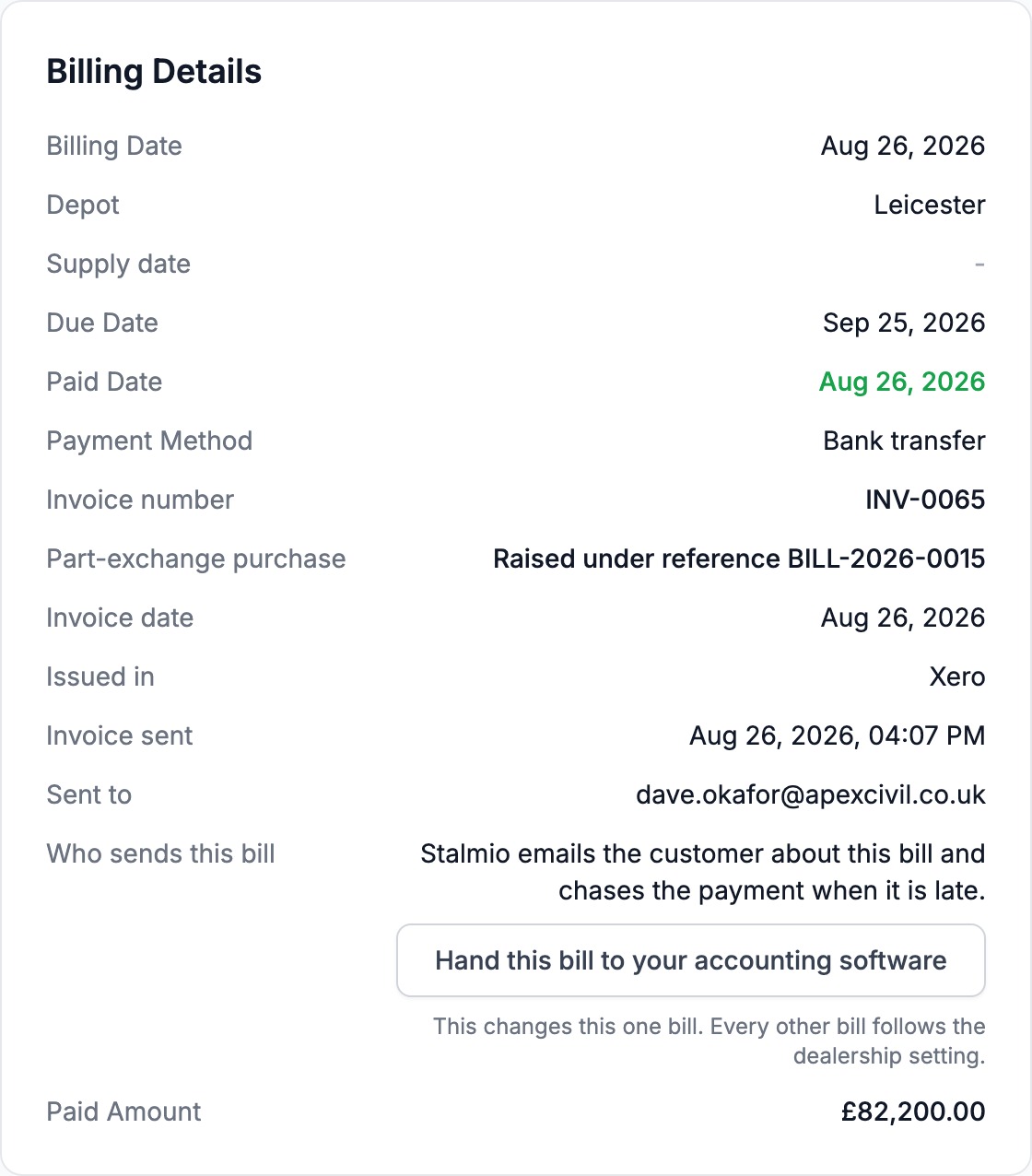
The bill shows it was issued
The Stalmio bill records that an invoice exists, which document it is and where it lives, and links straight to it. If it is later paid at the issuer, the bill can be refreshed from that rather than guessed at.
For your accountant
- Stalmio is not the issuer. The VAT invoice is raised in your accounting system, keeps its numbering there, and that document is the legal one.
- A scripted month of British and Polish dealer activity is posted line by line on every build and checked against what you would expect to see: VAT on sales, net sales, and aged debtors by customer.
- Deposits sit on a liability until the supply happens, and are applied when it does. A deposit request is never sent as an invoice, and a pro forma is not sent at all until it converts.
- One invoice per bill. A retry re-reads the invoice that already exists instead of creating a second one, so a dropped connection cannot leave you with a duplicate.
- Nothing is sent blind. The dry run shows the exact payload the push will send, built by the same code that sends it, so what you review is what goes.
What you get today
- Approved bills arrive in Xero or wFirma as sales invoices, carrying your customer, your account codes, your tax rates and the supply date.
- Every push is previewed in full before it goes, and you see the exact payload the accounting system will receive.
- The invoice keeps your accountant’s numbering and stays their document, so KSeF and Peppol are handled where they already are.
Questions dealers ask
- Does Stalmio issue invoices?
- No. Stalmio produces a commercial bill, and the VAT invoice is raised in Xero or wFirma, where it keeps its numbering and where the legal document lives. That is a deliberate position rather than a gap: the issuer carries the obligations that come with issuing, which in Poland includes KSeF, and elsewhere Peppol where it applies.
- What happens to a deposit?
- It is posted to a deposits-held liability account rather than to revenue, because money taken before a supply is not yet income. When the sale or the hire completes, the deposit is applied against the invoice and the liability clears. The deposit request itself is never sent to your accounting system as an invoice at all.
- What if we cancel a bill after it was sent?
- The invoice at the issuer is voided if nothing has been paid against it, and credited if something has. Stalmio never edits or deletes a document your accounting system has already numbered, because in most places it must not be possible to.
See it on your own stock
A demo is a conversation, not a slideshow. Bring your machines, your hire fleet and the part of the week that annoys you most.
Book a Demo